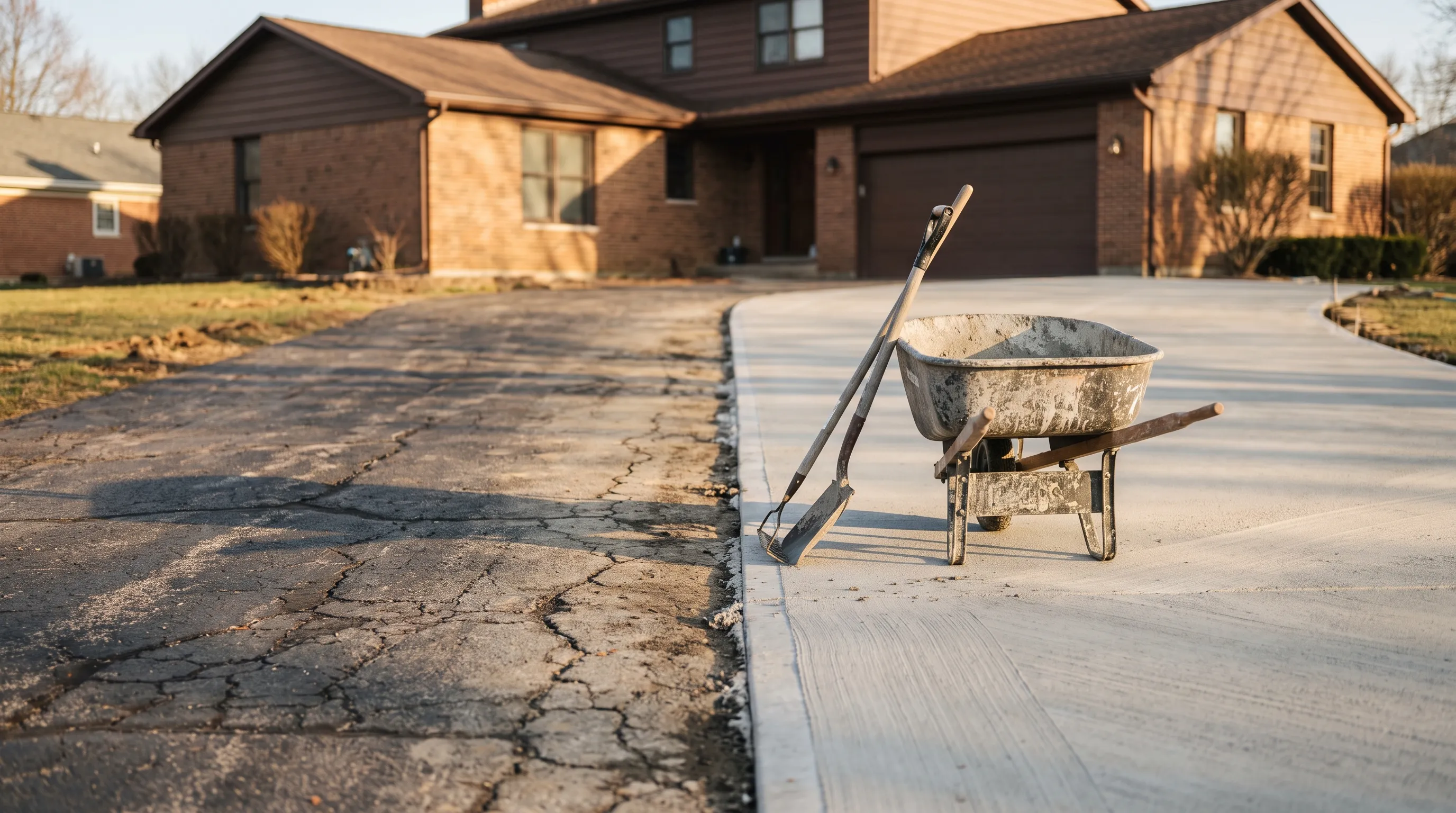
Concrete repair in Hunt Club
Hunt Club's housing is unusually concentrated in one twenty-year window — Campeau, Tartan, Urbandale and Richcraft built most of Hunt Club Estates, Hunt Club Chase, Hunt Club Woods and Hunt Club Park between 1976 and the early 1990s — so entire streets are aging out together, not one house at a time.
Concrete repair in Hunt Club
Hunt Club's housing is unusually concentrated in one twenty-year window — Campeau, Tartan, Urbandale and Richcraft built most of Hunt Club Estates, Hunt Club Chase, Hunt Club Woods and Hunt Club Park between 1976 and the early 1990s — so entire streets are aging out together, not one house at a time.
What we see most in Hunt Club
Most original Hunt Club driveways were built in asphalt, the era-typical, lower-cost choice for a 1970s–80s production home, so a lot of what we do here is a first-time upgrade to concrete or interlock rather than a repeat repair. Foundations from the same era are poured or block, with basic weeping tile that's now well past its design life. The soil underneath varies more than people expect: most of Hunt Club sits on shallower soil over bedrock, which is comparatively low-risk for settlement, but pockets nearer the Rideau River and Hunt Club Creek do have clay or unconsolidated soil — it genuinely depends which street you're on.
That river and creek edge is worth calling out specifically: Hunt Club Creek's control dam near Riverside Drive is already close to the practical limit of what it can hold back without flooding adjacent basements, so foundation moisture control gets extra attention on that side of the community. Inland streets built by the same production builders in the same narrow window tend to need foundation and parging work in the same few years, which is why a neighbour's project is often a preview of your own.
Most requested in Hunt Club
All services in Hunt Club
Hunt Club questions
+Our whole street's driveways look like they're falling apart around the same time — why?
+Is our soil the clay everyone talks about in Ottawa?
Nearby areas
Not on the list? If you're within about 30 minutes of these areas, we'll still come look.
Get a free estimate this week.
Send a photo of the problem and we'll tell you what it needs. Most quotes are on site within a couple of days.
Call 613-912-7565Request an estimate online ›Ottawa, Ontario & surrounding areas
613-912-7565
Open 7 days, 9:00am–9:00pm
Licensed & WSIB insured